

In this article
- Why are motorcycles so easy to steal in Spain?
- What types of motorcycle GPS tracker are there?
- What to check before buying a GPS tracker for your bike
- Where should you hide a GPS tracker on a motorcycle?
- What if the motorbike battery runs flat?
- My motorbike has been stolen and it has a tracker: what do I do?
- The Vehistrack motorcycle GPS tracker
- Frequently asked questions
A motorcycle GPS tracker is a small device with its own SIM card that sends your bike's position to your phone and alerts you if someone moves it, knocks it over or disconnects it. For most riders in Spain, the best option is one wired to the bike's battery, water and dust resistant, and hidden somewhere not obvious (under the seat, in the tail section or behind the fairing). Here is how to choose one, where to fit it and what to do if one day your bike is not where you left it.
- A motorbike can be stolen in seconds: two people lift it into a van without ever starting it.
- According to a study by the Spanish insurer Línea Directa, 82% of motorcycles in Spain have no theft cover.
- Choose a tracker with a SIM and data included, water and dust resistance, and alerts for movement, falls and disconnection.
- Hide it where a thief will not look first, with no metal on top blocking the signal.
- If your bike is stolen, give the location to the police. Do not go after it on your own.
Why are motorcycles so easy to steal in Spain?
A car has to be opened, started or towed. A motorbike does not. It is light, it has no doors, and two people can lift it into a van in less time than it takes you to order a coffee. A disc lock or a chain helps, but it does not stop them carrying the bike away.
Then there is insurance. According to a study by Línea Directa covering 2019 to 2023, 82% of motorcycles in Spain have no theft cover (compared with 22% of cars). In other words, if your bike is stolen, in most cases nobody pays you for it. The same study says that around 70% of vehicle thefts were never solved.
Spain recorded 33,032 vehicle thefts in 2025, around 90 a day, according to the Crime Report of the Spanish Ministry of the Interior (Balance de Criminalidad). The Ministry does not publish a separate figure for motorcycles, but any rider who lives in a Spanish city knows someone whose bike has gone.
That is why, on a motorbike, a tracker is not a luxury. Often it is the only realistic way of getting the bike back.
What types of motorcycle GPS tracker are there?
Not every device that "finds" things does the same job. These are the three main groups:
| Type | How it works | Pros | Limits |
|---|---|---|---|
| Battery powered | Loose unit with its own rechargeable battery | Can be hidden anywhere, no wires | You have to recharge it; if it runs flat, it stops alerting you exactly when you need it |
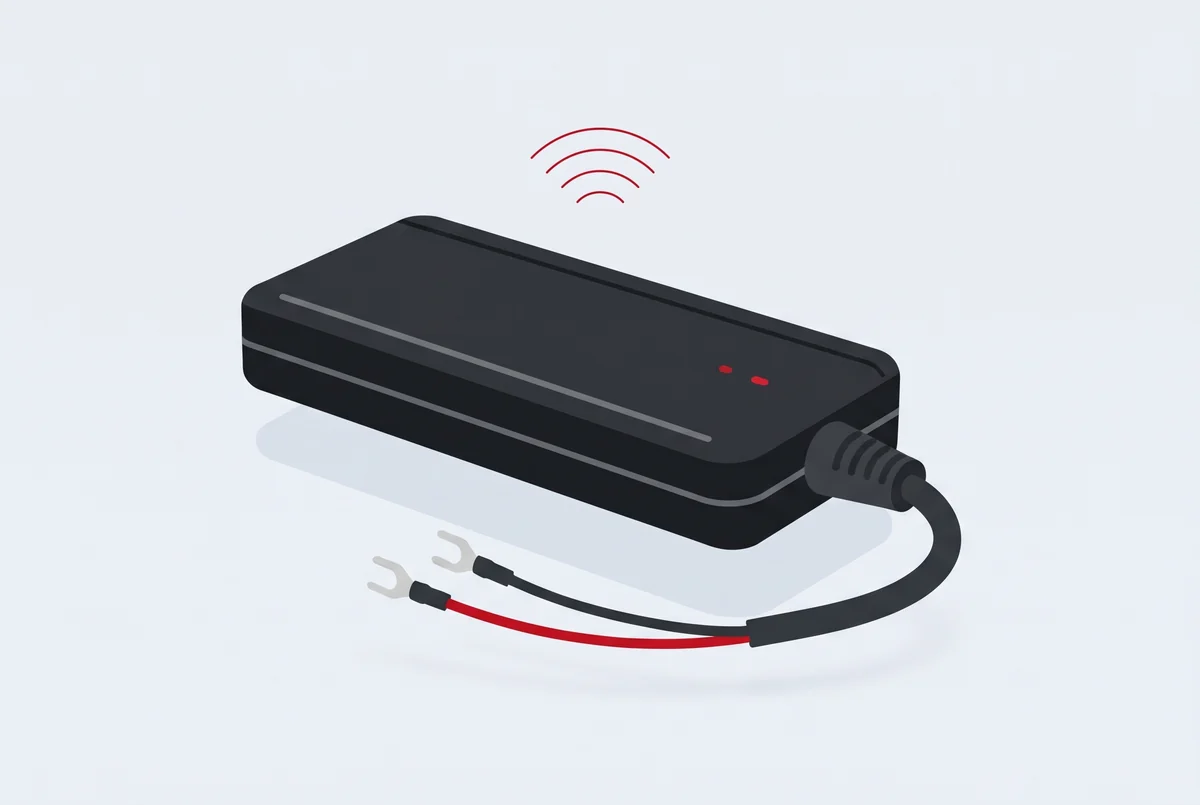
| Wired to the bike's battery | Powered by the motorcycle battery through two wires | No charging to remember; can alert you if it is disconnected | Needs a small, tidy installation |
| AirTag and similar | Item finder tags that rely on nearby phones | Cheap, small, no subscription | Not GPS: they only update when a compatible phone passes nearby; no movement or fall alerts; and they can warn the thief that they are carrying someone else's tag |
AirTag style tags are made for finding your keys, not for protecting a motorbike. They are designed to warn anyone carrying a tag that is not theirs (an anti stalking feature), so a thief with a phone can find it and throw it away. And in a garage or a warehouse with nobody around, they simply do not update.
For a bike that sleeps on the street, the most reliable choice is a GPS tracker with its own SIM, powered by the motorcycle.
What to check before buying a GPS tracker for your bike
Before you look at the price, go through this list:
- SIM and data included. The tracker needs a connection to send its position. Check whether it comes with a SIM, how much data is included and for how long.
- Subscription. Some trackers are cheap to buy and expensive to keep. Add up the cost of the device and what you will pay every year.
- Water and dust resistance. A motorbike gets rained on, hosed down and covered in dust. A device designed for a car dashboard will not cope in the same way.
- Fall alert. It tells you if the bike ends up on the ground, whether someone has knocked it over or is trying to load it.
- Movement and disconnection alerts. What matters is not knowing where the bike is, but finding out the moment someone moves it or rips out the tracker's wires.
- Battery drain. If the bike stands for weeks, a tracker that draws a lot of power can leave you unable to start it. Ask how it behaves while the bike is parked.
- Where the alerts arrive. Yet another app to open gets forgotten. A WhatsApp alert is something you see straight away.
Before you buy, ask what happens when the SIM data runs out and how much it costs to carry on. That is where many "cheap" offers stop being cheap.
Where should you hide a GPS tracker on a motorcycle?
The golden rule: put it where a thief will not look first. Someone in a hurry checks the space under the seat and around the battery before anything else. If you fit it there, hide it properly, so it is not in plain sight as soon as the seat comes up.

Under the seat
This is the easiest place: the battery is right there and the device is protected from the rain. The problem is that it is the first place anyone looks. If you use it, put the tracker under a cover or inside a sleeve, not loose on top of the battery.
In the tail section
At the back of the bike, under the tail panels, there are usually gaps big enough for a small device. You have to remove plastic panels to reach it, which works in your favour. Make sure it is not next to the exhaust or anywhere that gets hot.
Behind the fairing
On bikes with a front fairing there is space between the plastic and the frame. It is a good hiding place and the plastic does not block the signal. The downside: removing the fairing takes longer and you need to know what you are doing.
Along the wiring loom
Fixed to the wiring loom with cable ties and tape, the tracker blends in with the rest of the wiring. It is one of the least obvious spots. Just make sure the loom is left as it was, with no strain or rubbing.
Tips for a safe installation
- No metal on top. GPS needs to "see" the sky. Under plastic it works fine; inside a metal box or stuck under the fuel tank, it does not.
- Fix it firmly. Use cable ties or strong double sided tape. Motorcycle vibration shakes loose anything that is badly fixed.
- Away from heat and direct water. Not next to the exhaust and not in the path of the spray from the wheel.
- A clean battery connection. Respect the polarity, protect the joints and disconnect the battery while you work. If you are not sure, ask your workshop: it takes a few minutes.
- Check it works. Before refitting the panels, check on your phone that the position is coming through.
What if the motorbike battery runs flat?
This is the most common question. A tracker wired to the battery uses little power while the bike is parked, but if the bike stands for a long time and the battery is already tired, everything adds up. If you are going to leave it unused for weeks (over the winter, for example), start it every so often or use a battery maintainer.
The good thing about this type of tracker is that if someone cuts the wires, you get a disconnection alert. That alert is an alarm in its own right.
My motorbike has been stolen and it has a tracker: what do I do?
First, and most important: do not try to recover it yourself. You do not know who has it or what state they are in. A bike can be recovered; a run in with dangerous people cannot be undone.
What you should do:
- Check it has not been towed. If it was badly parked, call the local police (Policía Local) or the municipal vehicle pound.
- Call 091 (National Police, Policía Nacional) or 062 (Civil Guard, Guardia Civil). Tell them the bike has a tracker and that you can give them its live location.
- Report the theft (denuncia). Take your ID (passport or NIE card), the registration number, the vehicle registration certificate (permiso de circulación) if you have it and, if you can, screenshots of the map showing the location and the time.
- Tell your insurer, whether or not you have theft cover.
- Keep following the location and pass it on to the officers if it changes.
With a tracker, your report stops being "my bike has been stolen" and becomes "it is here right now". That makes a real difference.
The Vehistrack motorcycle GPS tracker
At Vehistrack we have a GPS tracker designed for motorcycles: it is wired to the battery, resists water and dust and alerts you to falls. With the Copilot plan (€4.99 a month per vehicle, no contract) you see the bike on the map in real time and get WhatsApp alerts for falls, for entering or leaving an area and for the tracker being disconnected. It comes with a SIM with 500 MB or 5 years of data, whichever comes first, and no separate connection fee.
And because Vehistrack exists so that nothing about your vehicle slips your mind, Jack, our WhatsApp assistant, also reminds you about the bike's ITV (Spain's compulsory roadworthiness test, the equivalent of the British MOT), its insurance and its services.
A motorcycle tracker with SIM included and WhatsApp alerts.
See the trackerIf you have a car as well as a bike, our car GPS tracker guide explains how the choice changes. And while you are checking the bike, see when your ITV inspection is due in Spain: motorcycles are exempt for their first 4 years and after that are tested every 2.
Frequently asked questions
Is it legal to fit a GPS tracker to my motorbike in Spain?
Yes, you can fit one to your own bike without any problem. It is a different matter to put a tracker on a vehicle that is not yours or that other people use, such as an employee; that is where data protection rules come in.
Can I use an AirTag as a motorcycle tracker?
It can help you find the bike in a crowded car park. As an anti theft device it falls short: it is not GPS, it depends on phones being nearby, it does not alert you to movement and the thief may get a notification that they are carrying someone else's tag.
Will the tracker drain my motorcycle battery?
A tracker wired to the battery uses little power while parked. If the bike is going to stand for a long time, start it every so often or use a battery maintainer.
Can I install it myself?
If you know how to remove your bike's panels and connect two wires to the battery with the right polarity, yes. If not, any workshop will do it quickly.
Is a tracker worth it if my insurance does not cover theft?
That is exactly when it is most useful. Without theft cover, getting the bike back is the only way not to lose its full value. And if your policy is about to expire, read what driving without insurance in Spain can cost you.


